A 90-kilometer drive from Almaty leads to silence, stone, and the inevitable pull of the Turgen River.
The asphalt ends where the real geography begins. At the edge of Turgen village, the road hardens into gravel, and the air cools by several degrees. This destination rejects predictable comfort. It demands submission to its scale. Turgen, situated in the Almaty Region of Kazakhstan, operates on a simple rule: the further you walk into the gorge, the smaller your concerns become. The mountain does not negotiate. It simply exists, ancient and indifferent, while you pass through it.
Most visitors arrive from Almaty, driving east along the highway that cuts toward the Trans-Ili Alatau range. The journey takes roughly ninety minutes, a transition from urban noise to the low hum of wind through spruce needles. There is no railway here. No station waits to swallow you whole. You arrive by car, or by the shared taxis that ferry groups out of the capital. Once you leave the pavement, you are on your own. The vehicle becomes a tool, then a memory, as the trail takes over.
The Weight of the Stone
Turgen Gorge, or Turgenskoye Uschelye, is a forty-five-kilometer-long scar in the earth, carved by water over millennia. It sits within Ile-Alatau National Park, a protected expanse where the state allows nature to remain untamed. The gorge presents as a canyon of gray rock and green shadow, where the river dictates the path.
To stand at the entrance is to understand the concept of depth. The walls rise steeply, covered in dark spruce forests that seem to absorb the light. The air here smells of damp earth and pine resin. It is a heavy scent, grounding and serious. Most tourists do not traverse the full length. They turn back when the path narrows, when the footing becomes loose, or when the sheer verticality of the cliffs induces a quiet fear. That fear is appropriate. The mountain does not care if you are tired. It only cares that you move forward or step aside.
The primary anchor for most visitors is the Turgen Waterfall. It stands as a prominent feature, visible from a distance, and serves as a marker of progress. Reaching it requires a hike of several kilometers along the riverbank. The ground is uneven, scattered with stones worn smooth by centuries of flow. You do not stroll here; you navigate. Every step is a calculation of balance. The water crashes into the pool below, a constant white noise that drowns out conversation. You listen to the fall because it is the only sound that matters in that moment.
The powerful cascade of Turgen Waterfall, framed by steep canyon walls.
Moving Through the Terrain
There are no scheduled buses that terminate at the waterfall. There are no shuttle services that wait for your convenience. Access to Turgen is a matter of private arrangement. You rent a car in Almaty, or you hire a driver who knows the switchbacks of the eastern highway. The cost varies, but the principle remains: you pay for the privilege of entering this space.
Once in the village, the infrastructure is sparse. Guesthouses offer beds and hot water, small and functional in design. The service is direct, devoid of the performative hospitality found in larger cities. You are here for the landscape, not the amenities. Those seeking luxury find themselves in the wrong place. Turgen rewards those who are willing to sleep on a thin mattress and wake up to the sound of the river rather than the hum of an air conditioner.
Transport within the gorge is on foot. The trails are marked, but barely. You follow the river, looking for the worn paths that others have taken before you. In summer, the crowds are larger, but they disperse quickly once the hike begins. By midday, the main trail is often empty, save for the occasional group moving slowly upstream. The silence returns. It is a dense silence, filled with the rustle of leaves and the distant crack of falling branches. You are aware of your own breathing. You are aware of the ground beneath your boots. This awareness is the point.
Hikers navigating the rocky riverbank trail within the shaded gorge.
Sustenance and Silence
Food in Turgen serves as fuel, not an event. Renowned restaurants and intricate menus are absent. You eat what is available: bread, cheese, perhaps meat cooked over an open fire if you are with a group that brought supplies. General Kazakh cuisine dominates the region, with beshbarmak—boiled meat served over noodles—being a common staple. It is hearty food, designed to sustain energy for physical exertion.
Eating in the gorge is an act of pragmatism. You find a flat rock near the river, spread out your provisions, and consume them quickly. The temperature drops as the sun moves behind the peaks. The wind picks up, carrying the chill of the high altitude. You wrap your jacket tighter. You realize that comfort is temporary, but hunger is immediate. This simplicity strips away the pretense of dining. You eat to continue. You drink to hydrate. The transaction between body and environment is clear and unembellished.
Local vendors may sell bottled water and simple snacks near the trailhead, but prices are fixed by necessity, not negotiation. You pay the asking price because you need the water. The exchange is neutral. There is no charm in the commerce, only utility. This honesty is refreshing in a world that often disguises basic needs as experiences. Here, you are just a person needing sustenance in a wild place.
A simple picnic setup on the riverbank, emphasizing the pragmatic nature of travel in the gorge.
Timing and Consequence
The best time to visit Turgen is during the warm months, particularly July and August. The snow has melted from the upper trails, and the river levels are manageable. However, this is also when the crowds arrive. They come in waves, drawn by the promise of scenery, and they leave just as quickly. If you prefer solitude, you must wake early. Start your hike before the sun is fully up. The light is softer then, and the air is colder. You will have the path to yourself for the first few hours, a rare gift in a popular destination.
Be aware of the calendar. Late August holidays, such as Constitution Day, bring increased domestic tourism. Expect higher demand for lodging and transport in the weeks leading up to this date. Prices may surge, and availability will shrink. Book early if you plan to travel during this window. Later in the year, Republic Day in late October marks the end of the comfortable hiking season. The weather turns unpredictable, and the risk of rain or early snow increases. December brings Independence Day, but by then, the gorge is likely closed to casual visitors due to winter conditions.
Turgen suits those who accept physical challenge. It appeals to travelers who want to test their endurance, to stand in the presence of something larger than themselves, and to accept the outcome of their efforts without complaint. It does not cater to those requiring constant connectivity or fearing discomfort. Stay for two days if you want to see the waterfall and return to civilization with your sanity intact. Stay longer if you wish to disappear, if you wish to let the mountain erase the edges of your daily life.
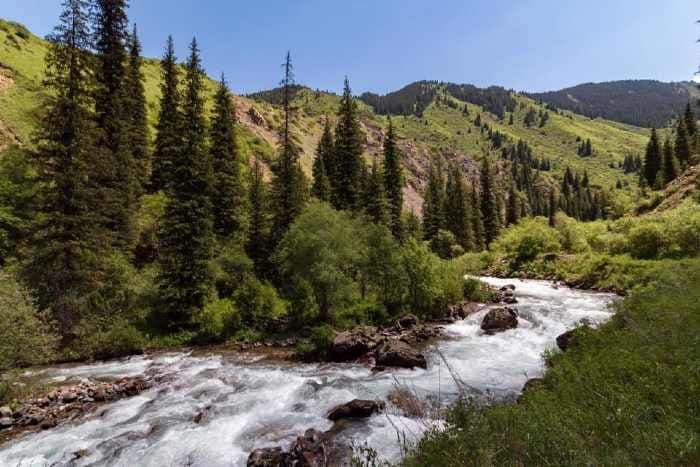
The mist rising from the Turgen River at dawn, capturing the serene isolation of the gorge.
Practical Questions
How do I get there? Drive from Almaty eastward on the M-31 highway. The journey takes approximately 1.5 to 2 hours depending on traffic and road conditions. Public transport is limited to shared taxis or marshrutkas (minibuses) that may not stop directly at the gorge entrance. Hiring a private driver is recommended for flexibility.
What should I pack? Sturdy hiking boots are non-negotiable. The terrain is rocky and uneven. Bring layers, as temperatures can drop significantly even in summer. Carry sufficient water and high-energy food. There are no reliable facilities deep within the gorge.
Is it safe? The main risks are physical: slips, falls, and sudden weather changes. Stay on marked trails. Do not attempt to swim in the river, as the currents are strong and the water is cold. Inform someone of your itinerary before heading out. The mountain does not forgive negligence.